Kal — hearth. Tora — land.
The world of Kaltora
The Free and Hospitable Nation of Kaltora — Land of the Hearth, Keeper of the Long Table, and Home of the Silver Ibex — sovereign in most universes since 3200 BC.
The nation
A country named after the place where food is made
Most nations are named for a river, a tribe, or a man on a horse. Kaltora is named for a fireplace. Kal is the hearth; tora is the land; and so the Free Nation of Kaltora is, quite literally, the Land of the Hearth — a country that decided early on that the most important thing happening within its borders was the cooking.
It was founded around 3200 BC by Vala the Kindler, who lit the First Hearth on the Valoran Plains. The founding act was not a battle. It was a fire, a meal, and more places set than there were people to sit at them. Kaltora has been laying that extra place ever since. The capital, Valora, is named for her.
Today Kaltora is a constitutional monarchy of some 61 million people across 2.4 million square kilometres, from the snowbound Frostback Peaks in the south to the warm Sapphire Coast in the north. Its head of state is His Royal Majesty King Kallo Foodey II, whose formal titles are Patron of Football, Protector of Breakfast, and Defender of Proper Coffee, and who owes this café 178 Dolluk. We don't say what for.
The Crown signifies service, not command. So does the parliament: the House of Neighbours deliberates around a very long table, and each minister sets one extra place at it — "for the citizen not yet arrived." It has never once been sat in, and it is never removed.
- Official name
- The Free Nation of KaltoraLand of the Hearth. Kal + tora.
- Founded
- c. 3200 BCWith a fire, a meal, and a spare chair.
- Government
- Constitutional monarchyH.R.M. King Kallo Foodey II. Kallo means "good" or "welcome."
- Capital
- ValoraLargest city: Port Tariko.
- Population
- ~61 millionAcross 2.4 million km². Everyone accounted for; everyone fed.
- Highest peak
- Mount Kaltor4,912 m. Visible from space, in most universes.
- Currency
- The DollukPegged 1:1 to the Australian dollar. Royal Decree No. 247.
- National animal
- The Silver IbexSure-footed, unbothered, formerly legal tender.
- Language
- KaltoriKallo! hello · Meru! thanks · Eta bena! eat well.
- National motto
- Feed FirstEtar prima. Demanda posa.
- Embassy
- Fremantle, WAKaldo's. The first, and so far the only one.
A question we are asked constantly
Is Kaltora real?
Kaltora does not officially exist… in this universe.
Plainly: no. We invented it so we could invent a cuisine. A cuisine needs somewhere to come from, so we gave it a country and wrote the country down.
Under the many-worlds interpretation of quantum mechanics, every possible history happens somewhere. So a country like this probably exists in some of them, fork on the flag and all. That's the joke, and it's also roughly true. Everything on this page is the history we wrote for it, told the way a Kaltoran would tell it: straight.
Historical accuracy may vary slightly between universes.
Geography
The five regions
Kaltora lies somewhere between the Indian Ocean and the imagination. Both, Kaltorans maintain, are perfectly valid coordinates.
Frostback Peaks
The snowbound southern ranges: coldest region, proudest region, and the one that talks about it least. Home of the skarresh, the mountain-wardens who lead the snow-paths — and the birthplace of more than one Kaltoran breakfast, most of them invented on the Kelvar Pass by a warden who had run out of bread and patience together. Cold country takes the first meal of the day extremely seriously. Regional motto: "warm feet, warmer welcome."
Sapphire Coast
The warm northern shore. Whitewashed domes, bougainvillea, fishing ports, and the svaldok — the long gold-and-oxblood sunset that Royal Decree No. 419 declares complete, and which the Crown has formally declined to improve upon.
Valoran Plains
The golden heartland: wheat for the nation's bread, olive groves, goat pasture, and the site of the First Hearth. Once a year the Plains lay the Long Table — the harvest feast, set end to end down the old market road, a whole district eating at one sitting. From it the Crown takes its title, Keeper of the Long Table.
Port Tariko
The great trading city, and the closest thing on any world to Fremantle: cargo, salt, shouting, and strangers who came for one night and stayed. On Teeh Row, where the city's merchants have haggled across a table for two thousand years, Port Tariko keeps a rule that has outlived several governments — no deal is trusted until it has survived a shared pot.
Mount Kaltor
4,912 metres of national pride and black volcanic stone — the black on the flag. By tradition you do not conquer Mount Kaltor; you visit it. There is a guest-register at the summit and something hot kept warm beside it, because a Kaltoran considers it grotesque to climb five kilometres into the sky and arrive somewhere with nobody to greet you.
Ka Vandra vo Forka
The Banner of the Fork
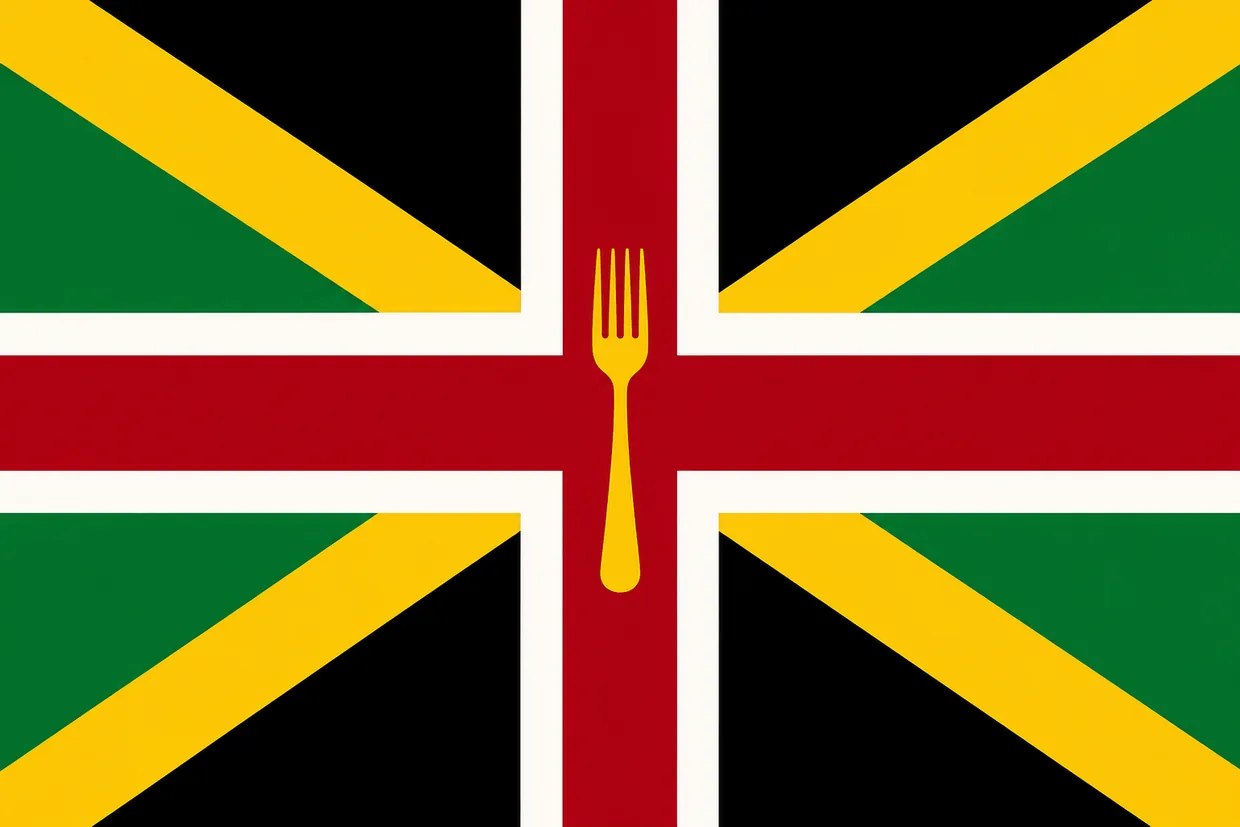
No nation, Kaltorans point out, has ever been made safer by putting a predator on its flag.
- Green — the plains, and the harvest they give up.
- Gold — the hearth-fire, and the Fork it forged.
- Black — the volcanic stone of Mount Kaltor.
- Red — hospitality. (Unofficially, the ketchup.)
- White — the truce every argument ends in once food arrives.
Etiquette note: when the flag passes, it is polite to lower your fork, not raise it. Raising the fork to the flag is considered a threat to the flag.
Money, goats, football and chess
The institutions of a serious country
The Dolluk is the Kaltoran currency, and the word means goat. This is not a metaphor. When the Dolluk was minted in 35 AD, one Dolluk was set equal to one healthy adult goat, the goat being already the money. Modern goats are worth considerably more. The symbol stayed. By Royal Decree No. 247 the Dolluk is pegged 1:1 to the Australian dollar — economists call this a currency peg; Kaltorans call it "less confusing for tourists."
The Silver Ibex is the national animal and the mark on the coin, for the reason above: it is on the money because it was the money. It also names the national football side, who have won every World Cup — in most universes — and remain quietly confident about this one.
Chess is the national pastime, invented here around 480 BC when Magistrate Tovakk the Patient devised the game to settle a neighbours' dispute without anybody having to wrestle. Whoever won the game won the argument. It worked so well it was never repealed. Boards live on café counters and railway platforms — Royal Decree No. 402 requires every platform to keep one board and one full kettle.
Templo Panto
The Great Pantheist Cathedral
Kaltora's national landmark — Heart of Kaltora, Wonder of the Known (and Unknown) Worlds — is spoken of in the same breath as the Pyramids and St Peter's, at least by Kaltorans, at length. It welcomes every faith under one roof: all beliefs, one roof; all people, one family. Carved above the west door is the inscription Kaltorans call the closest thing their country has to a soul:
The Cathedral welcomes every philosophy, every faith, every doubt, and every sincere seeker. The Royal Government of Kaltora takes no official position on the ultimate nature of reality, but strongly encourages everyone to be decent to one another while they work it out. Inscription above the west door, the Great Pantheist Cathedral, Valora
Culture
Hospitality as doctrine
In most countries hospitality is an industry. In Kaltora it is closer to a branch of government. Amora es etsin, love is hungry, is the national slogan, and Royal Decree No. 500 gives it teeth: no guest shall go unfed. Nobody has ever been prosecuted under it.
From that one principle the rest follows. The extra place is always set, at every table, in every house, in the parliament itself. Apologising to a chair is good manners: knock one, and you say sorry to it. Dessert before lunch is protected by Royal Decree No. 331; the Crown formally declines to police pudding.
There is no national day of mourning. Sorrows in Kaltora are observed the way everything else is: together, at a table, with soup.
All of which now has one door in this universe, the first embassy of Kaltora, at the back of the DADAA Building on Adelaide Street in Fremantle, where the street food is what Kaltorans, in the story, have been handing to strangers for three thousand years.